

OSR: Luck-based Magic Items

Jester Coins:
Golden Coins, one side stamped with a young man, clad in motley, winking at the viewer. The other side is marked by a woman, laughing and pointing at the viewer, as if mocking him. The coins are heavy and almost always found in small groups, from three to seven. The young man represents Fortune, the God of Luck. The woman represents his twin sister, Misfortune, Goddess of, well you know.
Abilities:
- Instead of making a d20 roll, someone with a Jester Coin can spend the coin to replace it with a coin flip or a d2 roll. If the creature receives the result of "Heads", treat the roll as if it was a "20". This will also grant the person the best possible natural outcome. For example, the Guard who heard him make a noise will see a cat and write the whole incident off as noise caused by the animal in question.
- However, if the creature receives the result of "Tails" instead, treat the roll as "1", with the worst possible natural outcome. For example, instead of just making a noise when the creature jumps onto the roof, the roof collapses and give way, dropping the creature into the guardroom.
- These items are consumable, so once used, a Jester Coin disappears.
Lucky Strike:
1d6+Atk
A seemingly plain one-handed sword of surprising sharpness. Upon closer inspection however, one can see the faint etchings of dice along the blade. When first picked up, the wielder will hear the sound of clattering dice, followed by exhilarated cheers.
Abilities:
- When attacking a creature, the wielder may "bet" that he rolled a higher damage number than the creature defending against his attack. The wielder then compares his damage+Atk to his opponent's.
- If the wielder's roll was higher, he can either add the difference in results to the damage he dealt, or he can roll 1d8 and add the result to the damage he dealt.
- However, if the wielder's roll was lower, then the opponent regains HP equal to the difference in the results.

Dungeoneer's Deck:
A deck of adventurer-themed cards, each one depicting either a familiar stereo-/archetype or an event that would be familiar to an adventurer. The femme fatale rogue, the mad wizard, the traumatized fighter, the unreliable map, etc. Many are smudged with dirt, stained with blood or smeared with some kind of viscera. They stink faintly of cheap booze and greasy tavern fare. The cards also seemingly stick together extremely well, they will never fall apart or become separated unless someone makes a conscious effort to draw a card.
Abilities:
- As an action, the user may draw a card from the Deck. This causes a unique effect depending on what card is drawn. Once a card is drawn, it disappears and is consumed. This continues until the entire Deck is gone.
- To see what effect a card has, roll on the table below:
1d20
1- The Deathblow. The next blow that hits you deals enough damage to either eliminate your Fighting Spirit or if you have none, reduce you to "0" HP. If you are already at 0 HP, then it does normal damage.
2- The Slurred Spell. The next spell cast by you automatically fails and triggers a Corruption roll. If you don't or can't cast any spells, then it affects the first spell cast near you.
3- The Suffocating Darkness. All visible light sources are immediately extinguished.
4- The Mad Wizard. The nearest spell-caster now has a 50% of his spells failing and triggering a roll on the Chaos table. This lasts for 1d6 hours.
5- The Thieving Rogue. Half of your current treasure disappears. You know it is hidden somewhere on this dungeon floor, or if you have cleared out this floor, on the floor beneath it.
6- The Berserker. The nearest warrior to you goes insane and cannot differentiate friend from foe. He will go on a 10 minute rampage and try to kill everything in sight until he is knocked unconscious or dead.
7- The Hidden Enemy. You detect some sign of approaching enemies, perhaps you hear footsteps or smell rotting meat or the Wizard senses the disturbing power of black magic. There is a 50% this is a hallucination. If not, it is very real.
8- The Dread Beast. The strongest monster in the area suddenly arrives and is very close to you. It doesn't appear magically (unless the creature can naturally do that), but instead simply arrives in some plausible manner.
9- The Poisoned Blade. The weapons of the next enemy you face are stained with some kind of toxic substance that either poisons, sickens or otherwise affects targets in an unpleasant way.
10- The Unreliable Map. You and your party are teleported to a random, unexplored room on this level of the dungeon (if in a dungeon). If in the wilderness or a city, you simply end up in a place you have never been within the same region. For example, if in a forest, you will be teleported to a new spot in the same forest. If in the city, you will be sent to a different district or neighborhood.
11- The Coil of Rope. You randomly receive a piece of adventuring gear. You are given 1d6 [1= A 50' coil of rope; 2= 1d3 torches; 3= A flint and steel; 4= A 10' ladder; 5= A roll of Bandages; 6= A bezoar stone (anti-venom/poison consumable.]
12- The Lucky Find. You receive a piece of equipment or a small reward that is something you desperately need. If you have no food, you find some. If you need light, you find a lantern and some oil, etc.
13- The Tempting Choice. You are given a vision of a nearby reward on this floor of the dungeon or otherwise nearby. For example, you could find out that three rooms over, there is a secret room full of jewels.
14- The Breadcrumb Trail. You are given the option to state a destination and then a trail of markers will appear to guide you to this destination. This destination must be something concrete. For example "Take me to the treasure" or "Take me to the exit" or "Show me how to get back to the village".
15- The Fair Maiden. You find a woman who is in distress. She is a real person with her own agency, but will likely be very grateful for being rescued. To determine her personality, roll on the 'Fair Maiden' table below.
16- The Healing Spring. You find a magical source of healing. This source of healing is able to heal 1d4 [1= A small amount; 2= A modest amount; 3= A large amount; 4= A miraculous amount.] The Referee should determine how much power the source of healing has based on the die roll and the level of the party- a life-saving spring at level 1 is far less valuable at level 5.
17- The Hoard. You find a massive amount of treasure, appropriate to the area. For example, if in a mine, you might find tons of gemstones or golden ingots.
18- Righteous Rage. One warrior or priest within sight (your choice) feels the desire to hunt down and destroy any evil beings within the local area. For example, if in a dungeon, the local area would either be the whole dungeon or the floor of the dungeon, depending on how big it is. As long as the affected creature does this, he gains +2 to Atk and Def rolls, the ability to sense the presence of evil creatures within 100' and immunity to possession, Charm and Fear effects. These benefits last for 1 hour or until the area is cleansed of all evil.
19- The Help of Heaven. You suddenly receive powerful back-up in the form of a righteous hero arriving in some kind of logical way. For example, if fighting a Demon Prince, an Archangel might teleport in, or if on a battlefield, a heroic paladin might ride to your aid. This hero will remain with you for enough time to solve your current problem and get you to safety, then he will return home or to his previous mission.
20- The Hero. You or one creature within sight (your choice) is restored to full HP, regains all their abilities and is granted +4 to Atk, Def and Damage rolls for 10 minutes or as long as it takes to finish any battle you are currently fighting in.
Who is this "Fair Maiden"?
1d6
1- Tavern Tramp. She's a loose woman, she might do it for money, or she might just like the beast with two backs. She has no real skills, but she'll be pathetically grateful that you rescued her. Don't get involved with her though, she'll drink away all your money and end up cheating on you.
2- Village Girl. She's a good girl who ended up in a bad place. Only really wants to go home. Other than this horrible incident, very innocent, she will easily fall for anyone dashing or handsome enough. Her skills include anything a farmwife would be expected to know: how to sew, mend clothing, make butter, take care of animals, cook, do laundry, etc.
3- Slave. She was going to be sold but then was kidnapped by monsters or ran away and then got snatched up. She's been trained to 1d6 [1= Be a concubine; 2= Dance; 3= Play Music; 4= Cook; 5= Be a scribe; 6= Teach upper-class children.] Regardless of how she was trained, she is obedient and pliable, as she has been trained to fear the lash and the whip.
4- Adventurer. She is a 1d4 [1= Warrior; 2= Priest/Cleric; 3= Rogue; 4= Wizard] of level 1d3. She will be 1 level lower than the weakest party member, or if the party is level 1, she will also be level 1.
5- Noble Daughter. She is from a powerful family. If you return her to her parents, you would be rewarded with money, ennoblement or other boons. She is either very sheltered or quite jaded (50%). She is trained in the courtly arts of dancing, singing, poetry, astrology and making clever insults that sound like compliments.
6- Princess. She is from the Royal Family. She is 1d4 [1= A lesser member, very far down the succession charts, like the King's uncle's daughter; 2-3= She is from the royal line, but low, 1d8+2 down on the order of succession; 4= She is the King's eldest daughter and in the absence of a male heir (or depending on the laws of the kingdom) the heir.] If she is not returned, there will be major political consequences. If she was returned to her parents, you would receive an enormous reward.

Bone Dice:
A small set of three d6s, carved of bone and etched with tiny runes. They hum with magical power and are slightly warm to the touch.
Ability:
- A creature should select either his STR, DEX or CON ability score, then eat the Bone Dice and roll 3d6. If the creature rolls higher than his selected ability score, his ability score increases to the rolled amount. If he rolls lower or equal to his ability score, he increases that score by +1, to a maximum of 18.
- For example: A creature picks STR and eats the bone dice. He has a STR of 12. If he rolls a 12 or lower, he increases his STR by +1. If he rolls higher than 12 however, he can replace the score of 12 with the result instead.

The Chaos Tome:
A leather bound book with a plain brown cover and a strange sigil stamped onto it. However, whenever you look away, the sigil slightly changes. Casual observers won't notice the difference, but if you're paying attention, you will note that it changes every time. Flipping it open will reveal it full of notes, diagrams and other bits of scribbles from a scholar of the arcane. However, the notes do not seem to flow from one page to another, as if each page came from a different book. Additionally, once you flip past a page, it will change to something else.
Abilities:
- The Chaos Tome causes any spell-caster who uses it to forget all spells he knows (or forcibly returns them to their spell-book, scroll or wherever they came from). The spell-caster cannot prepare any of these spells.
- Instead, each day the Tome will randomly conjure 1d6+3 spells for it's user. The user can choose to prepare these spells or not, but he may only cast these spells for the rest of the day.
- When the user takes a long rest, he will automatically forget these spells and the Tome will select new spells for him to use.
- 1/Day, the user may ask the Tome to refresh it's picks and select some new spells. The Tome will comply, but since this is annoying for it, it will only provide him with 1d6+1 spells instead.
The Wand of Wonder:
A small wand of cloudy glass that is studded with large fake gems made of colored glass. These gems change color when no one is looking at them. The handle is made of wood, wrapped in zebra hide. The wand makes random noises if you press it to your ear and listen, anything from screams to farting sounds.
Abilities:
- 3/Day, the user should select a target or object within 50' and then roll on the Referee's favorite "Random Magical Effect" table. That effect occurs to the creature or object targeted. If the effect is harmful and targets a creature, the Referee may grant a saving throw to mitigate the effect. However, the Referee may also choose not to, depending on the seriousness of the effect.
- You can use the wand to shoot blasts of magic that do 1d6 points of damage. At the start of each day, roll 1dX on the 'Elemental Damage' table to determine what kind of damage the wand does.
What Elemental Damage does the Wand of Wonder do today?
1d8
1- Fire
2- Acid
3- Radiant
4- Poison
5- Ice/Cold
6- Psychic
7- Lightning
8- Necrotic
Goblin Box:
A red box with shiny metal trim. The sides are painted with Goblins wearing spangly costumes. The top is marked with three question marks, one seemingly made of gold, one silver and one bronze. The box makes a rattling sound when shaken. Whenever it is opened, it makes a loud sound effect. For example, if you get a bad result, it might make a loud farting sound or giggling goblin laughter. If you get a good result, it might be a chorus of applause or a loud "Oh fuck, he did it!"
Ability:
- 1/Day, the Box will allow you to swap an item. You may place an item inside the box, then close it. Then roll 1d8. The box will then provide you with a new item in exchange. To see what this item is, roll on the table below.
The item is...
1d8
1-2: A worse version of what you put in. If you put in a sword, you get a wooden sword, or a cursed sword.
3-6: A similar item, but different in some way. If you put in a sword, you get an axe or a spear.
7-8: A better version of what you put in. If you put in a sword, you get a masterwork sword, or one with a lot of fancy decorations.
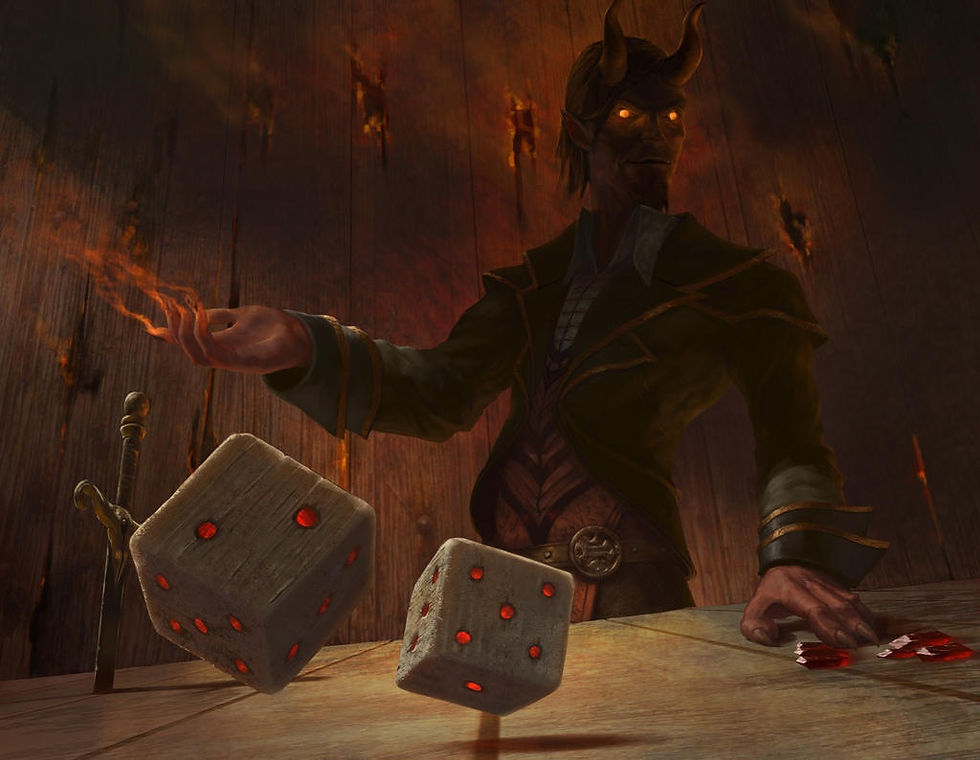
Demon Die:
A magical d6 made of dark stone, with burning symbols on each face. Looking at the symbols for too long will cause you to get a headache. When held in the hands, the user of the die is paralyzed by indecision, as if he cannot make a decision. The longer the die is held, the greater the temptation is to roll it.
Ability:
- 3/Day, you may roll the die. Roll 1d6 on the table below. Depending on what result you roll, that will cause a creature to appear. That creature will behave based on it's personality. The die grants no power to control the summoned creature.
- If a creature was already summoned today, reroll that result. If you roll the creature again, it is summoned as per normal.
- However, the summoned creature can be dismissed early if the owner of the die beats it in a COG contest. If not dismissed, a summoned creature will remain for the duration listed.
- Summoned creatures remember everything that happened to them from previous summonings.
- If killed, a summoned creature will be unable to be summoned until the next day. However, they cannot be permanently killed unless the die is destroyed.
What creature is summoned?
1d6
1- Hangu-Mara, The Butcher's Bride. A huge, six-armed woman with the lower body of a snake. She has huge viper's fangs, six eyes and a thirst for blood. She is a bloodthirsty killer and sadist, she loves violence, fighting and killing. She will attack any target you direct her towards, though unless a battle is satisfying, she might try to fight you as well. Weakness: Her love of violence is pathological, she cannot resist a fight, no matter how easy or obviously suicidal. If confronted with the chance to fight, she will take it. She has 6 HD, AR 3 and an Atk of 1d8+3. She has 4 Action Points. She also has the ability to parry attacks, reducing the damage by 1d8 (costs an Action Point), regenerate 1 HD (3/Day) and can throw her swords so good they do normal damage on a hit, as if she hit you with them. Will remain for 10 minutes or until she runs out of things to kill (you count).
2- Carino Kalazan, Monarch of Malice. A beautiful man with horns, three wolf tails and two extra heads emerging from his shoulders (tiger on the right, goat on the left), Carino typically appears on a throne, wearing nothing but a cloth-of-gold loincloth and elaborate jewelry. He is extremely arrogant and short-tempered. Flatter him and he will be very willing to listen to you. Insult him, get him dirty or fail to pay attention to him and he will become extremely unhelpful. Weakness: He wants to escape his imprisonment in the die and is willing to do almost anything to secure his freedom. He has 8 HD, AR 4 and an Atk of 1d6+2. He has Three Action Points. He has the ability to cast spells, with 8 MD and being able to memorize 8 spells at once. He specializes in protection, necromancy and direct-damage spells. He knows many other spells and is a capable scholar of magic. He will remain for 1 hour or until dismissed. He will also leave if particular insulted, though he will usually try to kill the offending party before he leaves.
3- Bajaka Sowanda the Metal-Handed. A towering, three-armed humanoid with armor fused into it's flesh. It's armor is decorated with gruesome heraldry and it carries a banner of flayed skin. Bajaka is an honorable warrior who wants to be needed and will seek a noble lord to serve. Note that his idea of "honor" and "noble behavior" are both very different than a human's. He will act as a bodyguard and can will fight valiantly to defend you. Weakness: Bajaka will serve anyone he deems as honorable, however his code of honor is very queer. If his liege asks him to break it or does something dishonorable, Bajaka will be consumed with rage and will attempt to destroy his master. Bajaka has 4 HD, AR 3 and an Atk of 1d8+2. He has 3 Action Points. He can also parry attacks (reducing damage by 1d8) and tell when people are lying around him (though not what specifically they are lying about). He will remain for 10 minutes or until dismissed. Unless he feels dishonored, he will always allow himself to be dismissed.
4- Fergori Vaza, Doctor of Sin. A towering creature with three mouths on it's broad face, no eyes and a mass of writhing tentacles. It's lower body resembles that of a huge centipede, though it moves like a centaur, keeping it's tentacles in the air. Speaks in a cultured voice and is highly knowledgeable about mortal bodies and medicine. Can provide healing and will lecture you about your bad habits. Can also perform autopsies and explain crime scenes. Weakness: Loves healing and working on the sick and injured so much it must pass a morale check to not do so. Will also try to convince you to go into dangerous situations so it can heal you. Also, because it swore a Hippocratic Oath, it will only use violence in defense of itself or it's patients. It has 8 HD, AR 4 and an Atk of 1d6+4. It has 4 Action Points. It has the ability to heal 3d6 HP (1/Day), heal 2d6 (3/Day) and can provide the services of a skilled doctor, as if it has a Medicine skill of +4. Can also diagnose all diseases and identify any poison presented to it. Will remain for 1 hour or until everyone is healthy, whatever comes first.
5- Yanatori Vespirala, Princess of Pageantry. A small creature that has the upper body of a human girl with blonde hair and three blue eyes. However, her lower body is a bit different, instead being a mass of writhing tentacles that allow her to move quickly across the ground. She wears a fur-timed mantle, a blouse adorned with seed pearls and gold thread and a crown. She also carries a royal scepter. She insists on being addressed as "Her Royal Highness" and will get snippy with you if you don't. She wants to be a Queen and rule over her own kingdom. Yanatori is very entitled and will insist that everyone should give her what she wants on the basis that she is just amazing. Weakness: Yanatori is very entitled, she will react badly to being denied any of her whims, throwing a tantrum. She has 3 HD, AR 2 and an Atk of 1d6+1. She has 2 Action Points. Yanatori can Charm creatures that fail a save (3/Day), walk on walls (at-will) and shoot freezing beams from her scepter (1d8+2 ice damage, every 1d4 rounds). She will remain for 1 hour or until dismissed. If she doesn't want to leave, she will throw a tantrum upon being dismissed.
6- Eriya Tralei, Harem Mistress. A creature that takes the form of a beautiful woman with horns, leathery wings and a living viper for a tail, Eriya is a seductive and charming figure. With her natural shapeshifting and the ability to sense arousal, she can take the form of whatever type of woman you fancy- a fact she will exploit. Eriya is a highly skilled manipulator, able to play people like fiddles. She uses her sex appeal, but also her intelligence, wit and other mental acuity to learn a target's needs and fill them as best she can. She is capable of altering her persona as easily as her soul. She will be whatever you need her to be, a depraved temptress, a cunning spymistress, a victim in need of saving, all the better to pull on your heart strings. And why does she do it? She craves power, at any cost. Her hunger for it is limitless. Weakness: Eriya is a coward at heart. She only fights when she has to and when she knows she can win- all other times, she will flee. She has 3 HD, AR 1 and an Atk of 1d6+1. She can shapeshift into any other type of humanoid (including men, though she often hides this), she can sense emotions, especially those similar to attraction and desire, she can fly and she can turn invisible (at-will). She also has the ability of Harem Mistress: For each soul she claims, steals or owns, she gains +1 HD, +1 AR (Max AR 5) and learns a new spell. She currently owns or possesses 0 souls. Eriya will remain for 1 hour or until dismissed.
<Sidebar>
Some of the creatures bound to the Demon Die are not happy with this arrangement and are attempting to escape their bindings. How they could potentially escape from this binding has been deliberately left vague and the Referee should feel free to invent their own method to fit whatever game they are currently playing. However, here are a few suggestions:
1. Demonic Pact
If a creature makes a pact with one of the creatures trapped in the die, this contract if correctly worded will override the bindings of the Die and free them. The contract must be worded to specifically account for this of course.
2: Die Destruction
If the Demon Die were to be destroyed, then all the bound creatures would be immediately freed. Note that this might not be ideal for all of them- as long as they were bound, they were essentially immortal, as if they died, their souls would just be returned to the die.
</Sidebar>

Comments